Opening hours:
Monday - Friday:2pm - 6pm
Monday - Friday:2pm - 6pm
18 December 2025 > 16 January 2026 Kindly invited to the opening of the exhibition by Eva Margon Štanta, Ana Rogel and Zvonka T. Simčič "Inconspicuous Roots", on Thirsday 18 December at 6. p.m. to the Alkatraz Gallery. The exhibition is a part of Mentorship+ module. Opening hours on 24.12. and 31.12.: 12.00 pm - 4 pm.
The exhibition Inconspicuous Roots thematises connection and community – also because three people are involved in this year's Mentorship+ project. In Mentorship+ project, which emphasizes a dialogic process between participants over a longer period of time and is based on non-hierarchy, Zvonka T. Simčič initiated the process of connecting and building a community, which began with the inclusion of two artists, namely: Ana Rogel and Eva Margon Štanta. In a collaboration based on curiosity about different perspectives and ways of working and on mutual learning, all three artists took on the roles of advisor, mentor, (co-)curator and artist, and prepared a final exhibition that brings together representatives of three different generations. In a shared space and time, they intertwined artistic practices, experiences and perspectives on the body, time and community.
Eva Margon Štanta builds her drawings and animations with precision that stems from a patient, almost meditative process. In her deliberate and slow-paced approach, images gradually purify themselves into silence. Ana Rogel, the youngest of the authors, uses her expression, based on female nudes, to raise questions of vulnerability, identity and he female body, caught between social demands and intimate truth. Her works open up space for subtle reflection on what it means to be visible and vulnerable at the same time. Zvonka T. Simčič, known for her performativity and unique ability to connect communities – both artistic and local – brings to the exhibition the physical experience of ageing as a public, almost ritualistic act of revelation. Her presence acts as a bridge between personal testimony and collective memory, between the changing body and a society that often pushes these changes out of sight.
According to the artists, the exhibition opens up space for reflection on what Carl Gustav Jung calls 'the path to individualisation' - the process in which the individual accepts the entirety of their being, including shadows, bodily changes, transience and inevitable transitions of life. In the installation, this process is revealed in three creative expressions that together embody the path: youth in search of form, maturity in sharpening one's gaze and old age in the courage to reveal oneself.
The leitmotif of the exhibition is ivy, which with its tenacity persists even in less nutritious soils and in darker and colder seasons. The artists are particularly interested in the dualities that ivy embodies. At first glance, it is gentle and delicate, but, simultaneously, it is irrepressibly persistent; it overgrows everything that tries to hold it back. As such, it becomes a metaphor for inner strength for the artists. Furthermore, it is a plant that, literally and literarily, connects buildings, trees and the ground with its shallow, but ramified and strong roots and woody, leafy stems. With its evergreen nature, it unites the past with the present and preserves life throughout the seasons; as a symbol of eternal life, it is common to various cultures and mythologies. In addition, it can cause an allergic reaction and is poisonous; it can protect from intruders and has healing properties; it acts as a support and warning. Its branching provides shelter for animals, thus connecting plant and animal ecosystems. As such, it connects several systems; rather than drawing nutrients from its support and weakening it, it provides shelter and protection. The artists employ it as a symbolic element, a connective tissue between youth, maturity and ageing.
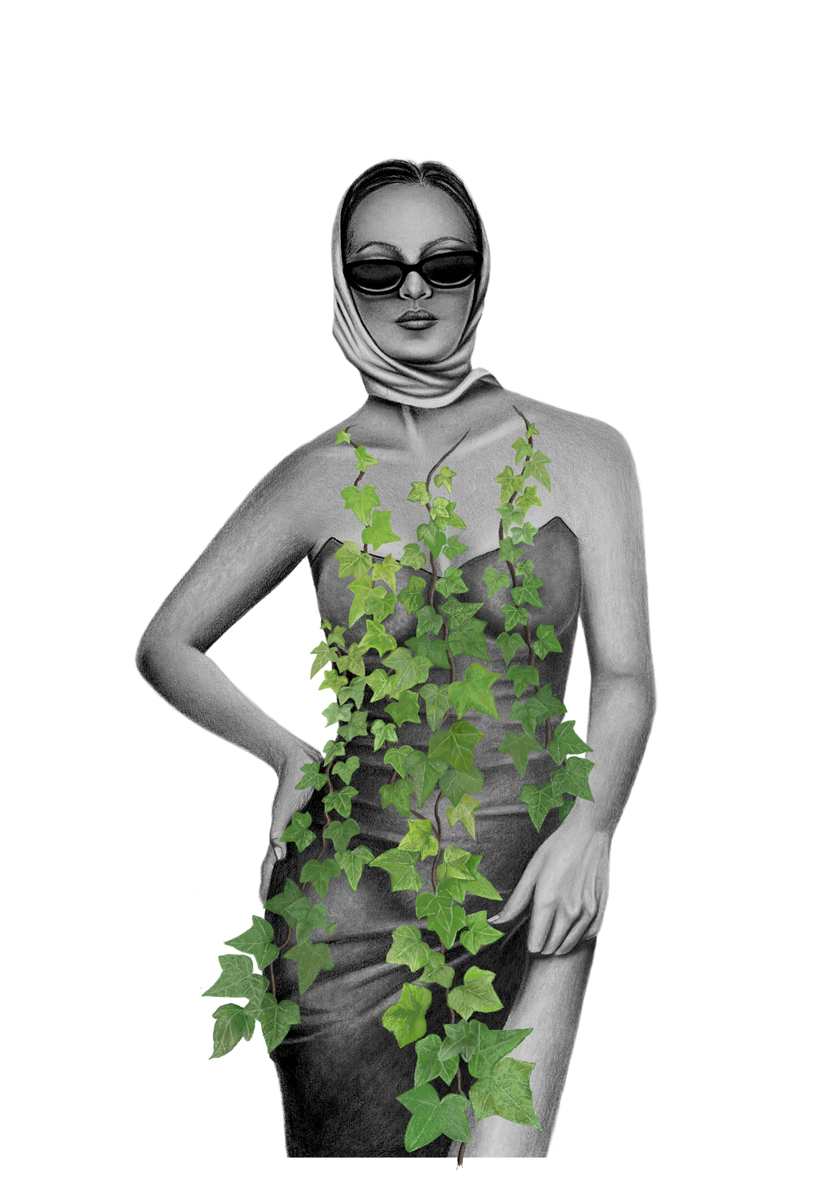
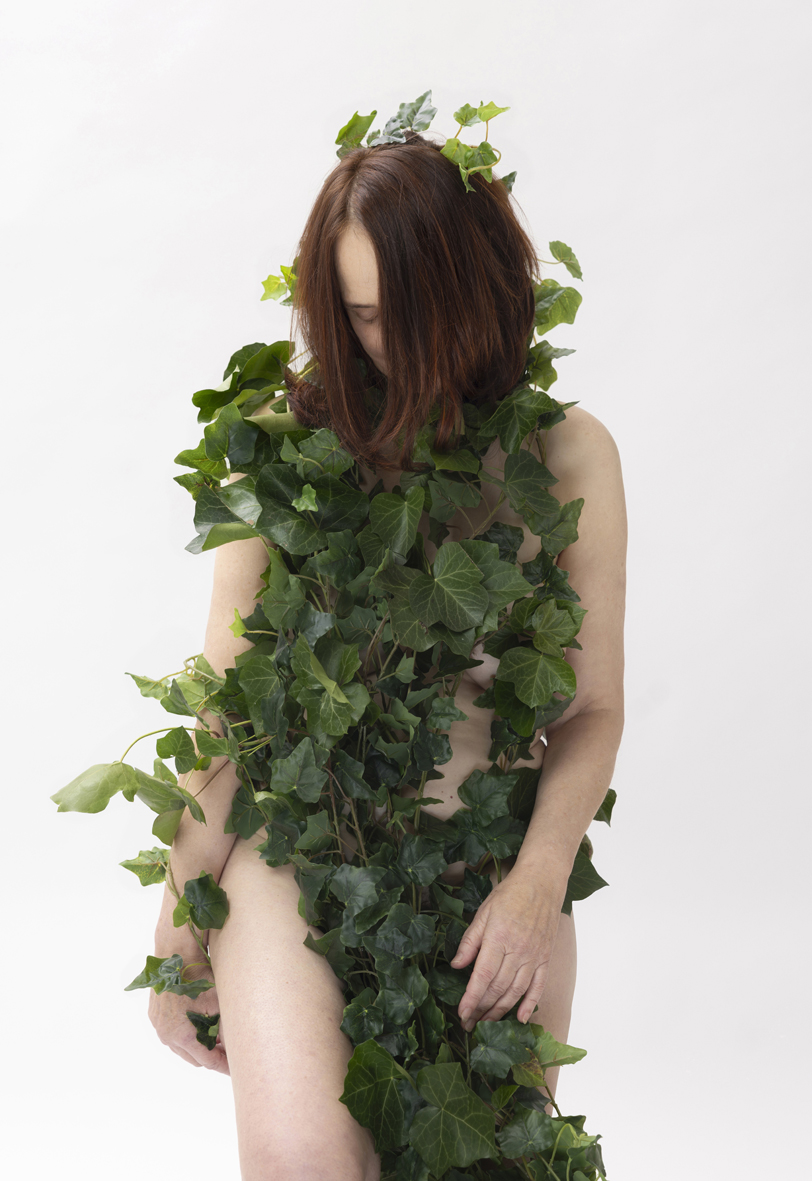
In the exhibition, the connective moment of the ivy is present already visually. Ivy is used in Eva Margon Štanta's animation, in which it overgrows Ana Rogel's work, entitled Lilit, a drawing of a female figure covered in a transparent garment. The video is linked to Nada Žgank's photograph portraying Zvonka T. Simčič's performative gesture, who is also 'dressed' in ivy, which covers and exposes her at the same time. If ivy connects the past with the present, it is interesting that Zvonka T. Simčič's groundbreaking work Doulas 'ad utero, ab ovo from 2007 also featured a veil. The photograph of performativity gesture in this exhibition, simultaneously, heralds a new series by the artist, conceived as a long-term process: every year at the same time, the artist will continue the performance, gradually revealing more and more of herself and bringing to the fore the theme of ageing and her own commitment to the truth about ageing, which society often hides or pushes into the background.
Contemporary visual art otherwise rarely deals directly with the topic of ageing and even more rarely places it in the context of personal confession or self-reflection. Ageing is a topic we tend to avoid, both as individuals and as a community; more often, it appears in the context of discussions about long-term care or politically charged referendums, such as the recent Voluntary Assistant Dying Act. Here, as well, the media discourse shamefully echoed the rhetoric of 'victory' of a certain political party, thus completely overlooking the central premise: that laws and rights are meant for people – and are not a polygon for political propaganda.
The three artists object to this with their Mentorship+ project, highlighting the importance of a community that opposes competitiveness and individualism, thus contributing to the well-being of humanity. Ivy here becomes a metaphor for the transformation of personal experiences into collective understanding, for organic connection and for subtle, yet persistent processes that shape our bodies, identities and the ways in which we position ourselves in the public space. The artists used its connecting momentum in the inter-generational intertwining for ramified and all-encompassing connection, thus literally enacting the purpose of the Mentorship+ module. The project surpasses the merely visual and tangible – the latter being merely a material anchor of the community they created. Their work is an installation, which acts as an inter-generational dialogue and a subtle reflection on the body, ageing, continuity and the transfer of knowledge. At a time when the media glorifies perfection, flawless bodies and robotic ideals, the installation draws attention to the real, fragile, strong and living body. To the body as a bearer of experience. To the ageing as part of growth. To the community that can only be built if we dare to see the whole – and share it.
Ana Grobler, Sebastian Krawczyk
Eva Margon Štanta holds a master's degree in illustration and works in the fields of illustration and animation. In 2015, she graduated from the Academy of Fine Arts and Design, University of Ljubljana, with her independent animated film Jason and the Argonauts. In 2019, she obtained her master's degree with the project Pictorial Map of Mountain Trails in the Logarska Valley, for which she received an Honourable Mention at the iJungle Illustration Awards (2020). Her works, most often characterised by scientific and natural history illustration, are becoming recognizable by their numerous lines and precise colour strokes, whereas in her graphic studio she complementarily explores and plays with reduction linocut. In her projects, she frequently intertwines animal and plant motifs. In addition, she has created a series of postage stamps for the Slovenian Post (2022). Her illustrations and animations are part of book projects and collaborations with institutions, such as the Slovenian Museum of Natural History and the Slovenian Forestry Institute.
Zvonka T. Simčič is the founder of the CCC Institute and its driving and creative force, surrounded by close friends and colleagues. In the field of contemporary art practices, she works in the areas of visual arts (video/film, intermedia art, installations, photography) and performance. All her works of art are strongly connected to the social space and her own experiences within it. She puts an emphasis on human existence, exploring the consequences of the social, economic and political situation with regards to power relations and the individual as a complete being in the social space. In doing this, she never forgets that human is also a spiritual being. In connection to new media, in her artworks, she becomes a 'living', yet unplanned actor/performer. In addition to studying at the Academy of Fine Arts in Ljubljana, where she also obtained her master's degree, she studied geomancy with Marko Pogačnik, classical spirituality at the University of Ljubljana with practical training as a spiritual companion, and gained experience of various spiritualities around the world. All this is reflected in her works.
Ana Rogel is a Slovenian artist whose work focuses on female nudes. She discovered her love of art in her childhood, whilst her passion for nudes developed in adulthood. Her drawings explore the beauty of feminine energy through realistic and semi-realistic depictions of women. She is particularly fascinated by extravagant and elegant figures with distinctive features, by means of which she redefines the concept of beauty in her own artistic way. She works primarily with graphite and pencil, although she has also developed a unique painting technique using coffee, known as 'Kafezije'. Through her artwork, Ana Rogel evokes sensuality, softness and powerful feminine energy, inviting the viewer to see women not as subjects, but rather as a force of nature. The charity auctions of her artworks, which she has held for people in need, are in fact very performative in nature. She draws inspiration from the human body, especially female body, which, for her, expresses extraordinary beauty and grace; every curve and movement inspire her as a painter to create new works of art.